

Biophilia in the Office.
How natural elements support concentration and well-being.
The discussion around office design has changed significantly in recent years. In the period following the pandemic, the social role of the office initially took center stage: interaction, exchange and collaboration were highlighted as key qualities of physical workplaces. At the same time, however, another priority has increasingly come into focus the ability to concentrate.
In the era of hybrid work, it has become clear how strongly the physical environment influences our attention. While working from home often offers individual retreat options, offices today must provide environments that support both interaction and focused work. For architects and planners, this means thinking about workplaces in a more differentiated way, as ecosystems of diverse spatial and atmospheric settings.
Within this context, one design principle is gaining increasing importance: biophilia.
The term describes the innate human tendency to connect with natural elements. From an evolutionary perspective, this connection is deeply rooted. For thousands of years, humans lived in close relationship with natural environments. Spaces that reflect this connection are still perceived today as more pleasant, stable and balanced.
In work environments where attention is a key resource, this quality can play a decisive role. For planners, this aspect is particularly relevant, as focused work depends strongly on the stability of the immediate environment. Visual calm, soft spatial transitions and a balanced sensory atmosphere help people orient themselves in space and maintain attention over longer periods of time.
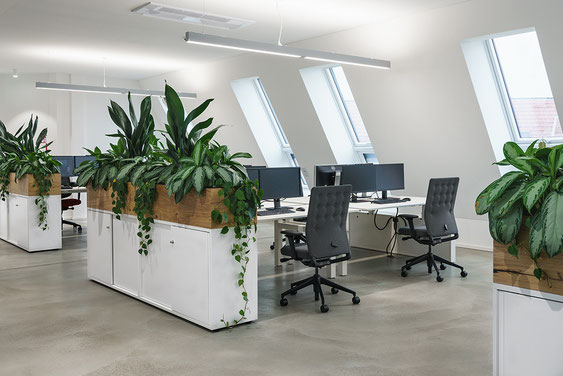
Nature as a stabilizing factor.
Studies from environmental psychology and workplace research show that natural elements in the office can have a measurable impact on concentration and well-being. Research conducted by the University of Exeter, for example, found that employees working in offices with plants can be up to 15% more productive. Additional studies also indicate that plants can reduce stress and improve performance in tasks that require focused attention.
Green plants, natural materials and visual references to nature can therefore help reduce mental fatigue and support the ability to concentrate. In this context, nature functions not only as a visual element but also as a sensory counterbalance within technically driven work environments.
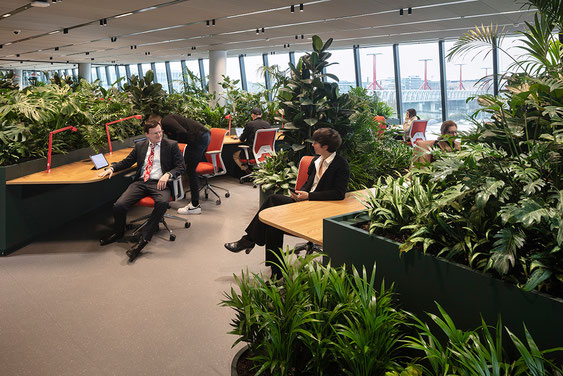
Biophilic design can therefore act as a subtle regulator of spatial perception. Plants structure spaces, create visual filters and contribute to a calmer spatial atmosphere without compromising the openness of modern office landscapes. Especially in hybrid work environments, where offices are increasingly becoming places for focused work, this quality can make a significant contribution.
Concentration requires differentiated spaces.
Hybrid work models have shown that standardized desk areas alone no longer reflect the complexity of today’s work tasks. Individual work involves different states of attention, from quickly answering emails to deep, uninterrupted focus.
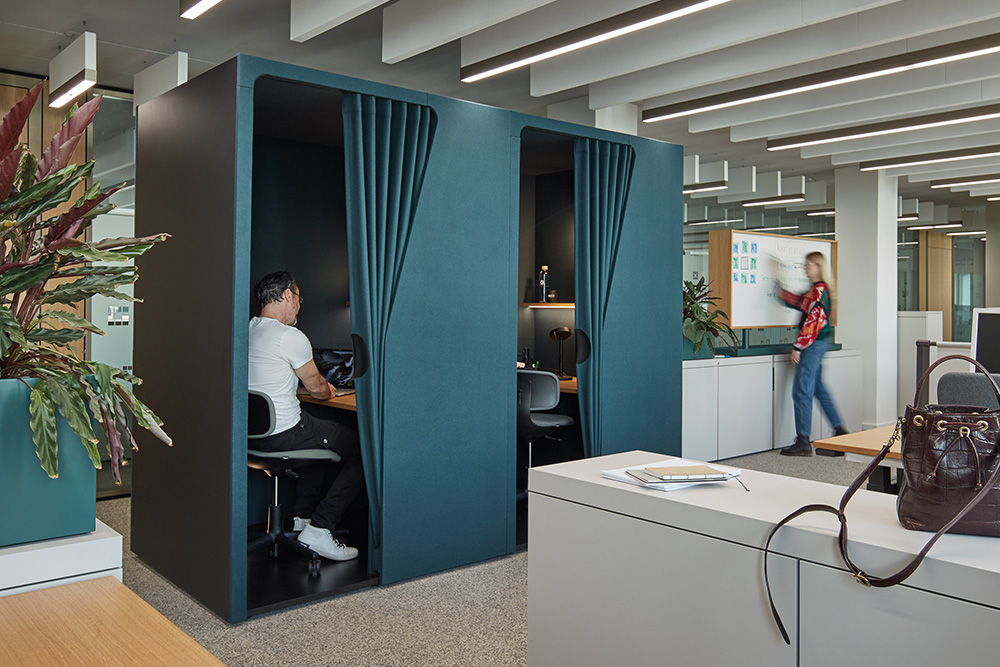
Modern office environments therefore require a variety of micro-environments: open communication areas, semi-private retreat spaces, quiet focus zones or informal work settings such as work cafés.
Biophilic design can support this differentiation. Greenery acts as a spatial mediator between different work zones and creates transitions without establishing rigid boundaries. Plants can define sightlines, reduce visual density and create protected areas that support concentrated work.
At the same time, natural elements contribute to the multisensory quality of a space. Together with warm materials, carefully designed lighting and acoustically calm environments, they create atmospheres that can be both calming and stimulating. An important factor for sustainable attention.




Integrating greenery into spatial planning.
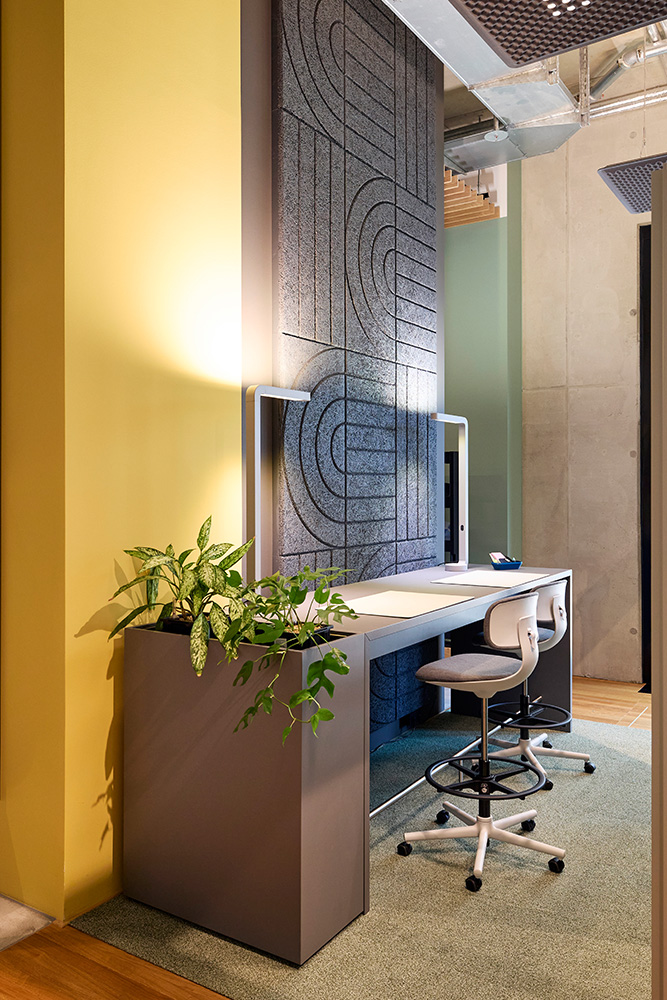
What matters is not so much the number of plants but how they are integrated into the spatial concept. Individual potted plants often serve primarily as decorative elements. Their full potential unfolds when greenery is systematically integrated into architecture and furniture.
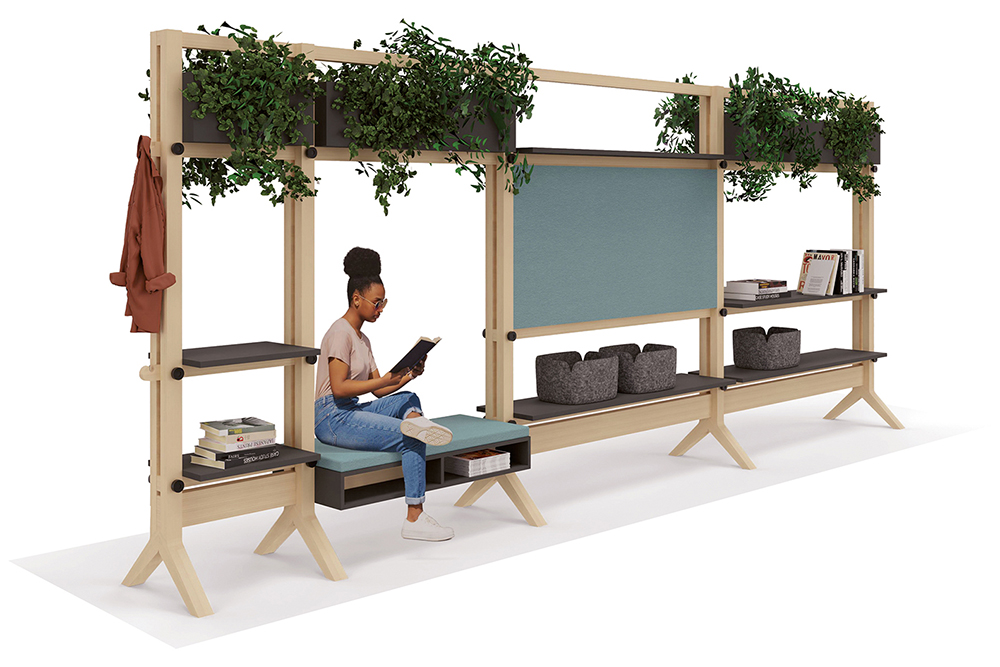
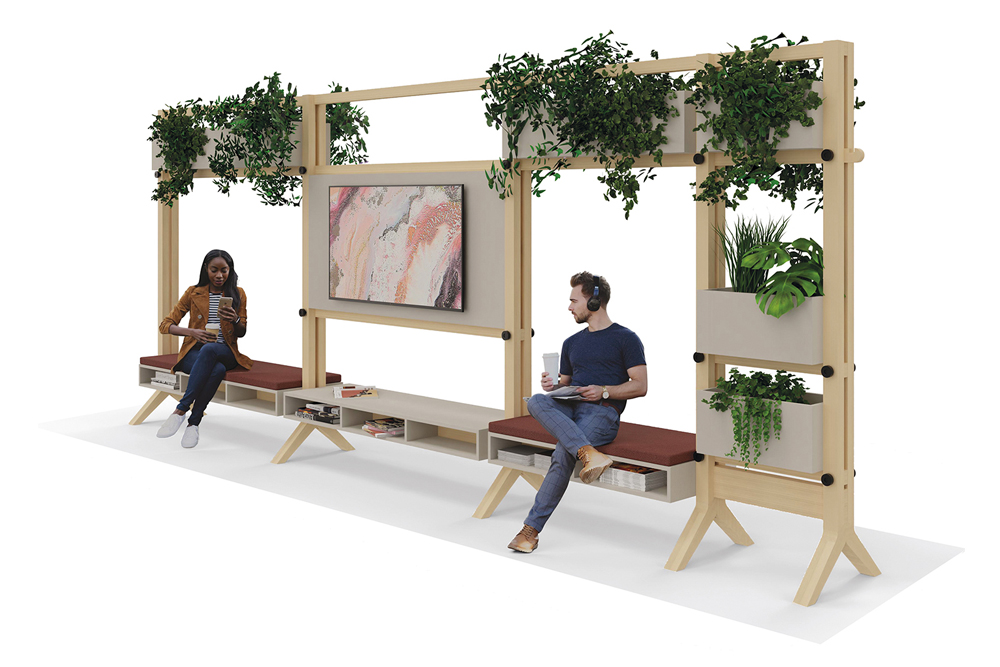
Plants integrated into furniture are not perceived as an add-on but as part of the spatial structure. They accompany circulation paths, define visual axes and create transitions between work zones.
Particularly in open office environments, this creates a natural spatial order that provides orientation while maintaining visual calm. Two essential factors for focused work.
Solutions for biophilic work environments by werner works.
With this in mind, werner works develops furniture systems that deliberately incorporate greenery as part of spatial design. Systems are conceived in such a way that plants can be integrated at the planning stage rather than added later.
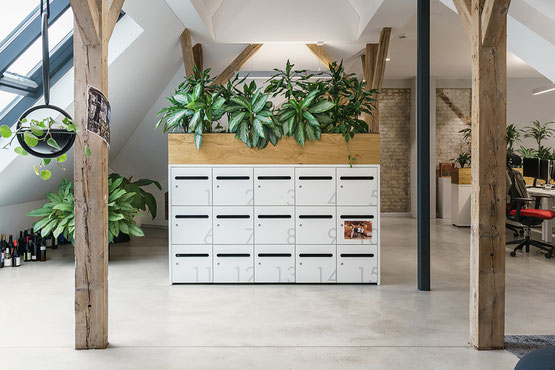
Planter boxes such as the 'basic top' attachments make it possible to combine storage, spatial division and greenery. They are placed on existing cabinet systems and create additional green layers within the spatial structure.
Modular systems such as 'HOCKEY' also allow planners to integrate plants directly into open structures. Planter boxes become part of the system and support the zoning of work areas without restricting their openness.
The result is work environments that are clearly structured in functional terms while creating a calm atmosphere that supports concentration.
Biophilia as part of focused work environments.
In hybrid offices, the physical workplace is increasingly becoming a place for tasks that require a high level of concentration. Accordingly, the importance of spaces that stabilize attention and reduce mental strain is growing.
Biophilic design can play an important role in this context. It combines spatial structure with sensory quality and creates environments that are both calming and inspiring.
For architects and planners, this opens up an approach that connects design, functionality and well-being. Greenery is no longer understood as decoration but as part of a spatial system that supports focused work.